Buying More Software Won't Fix Your Systems
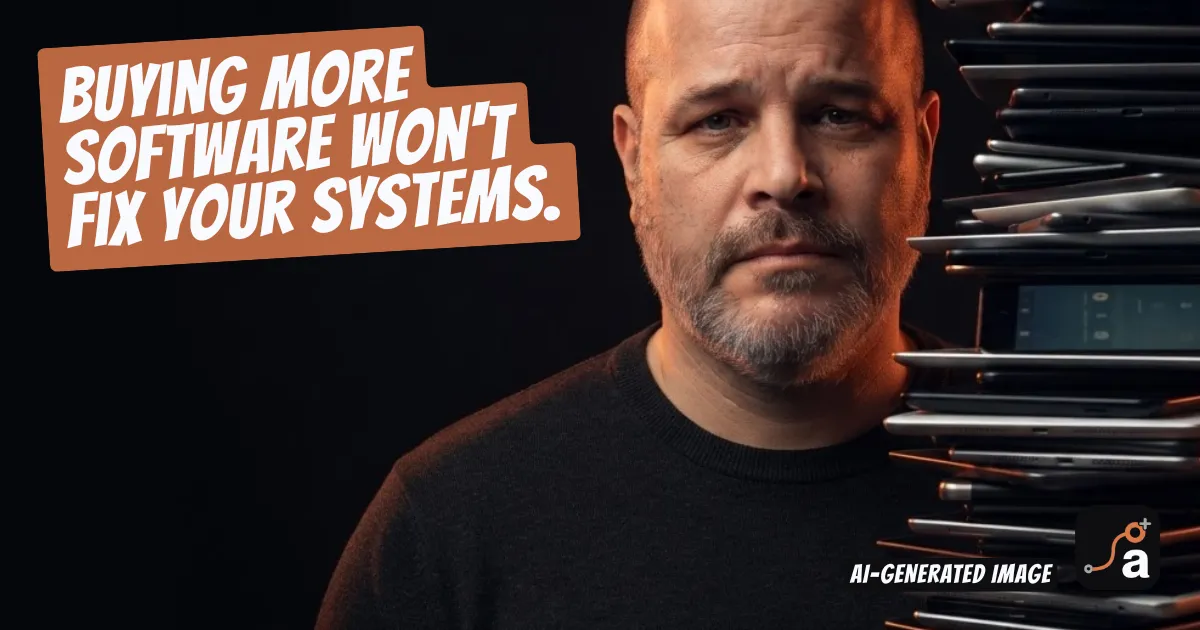
Most Solo BizOwners I speak to aren't short of tools. They've got a CRM they barely log into, an email platform they set up eighteen months ago and never finished, a scheduling tool, a landing page builder, something for proposals, something else for contracts, and a Zapier account holding it all together with digital string. The software graveyard is real, and it costs more than just the monthly subscriptions piling up on the credit card.
The instinct when something in the business isn't working, is to go looking for a tool that fixes it. Lead follow-up slipping through the cracks? There's an app for that. Client onboarding feeling clunky? Someone on a Facebook group will recommend three options before you've finished typing. It feels like progress because it looks like action. BUT... trust me, it isn't.
Tool-Stacking Isn't the Same as Building a System
A system is a set of connected processes that produces a reliable outcome. A collection of software subscriptions is not a system. It's simply a collection of software subscriptions. The difference matters more than most people realise until something breaks and they can't work out which of the 17 tools they have caused it, or why.
I've spent a long time working on software implementation, including projects for organisations like CERN, ITV and the Ministry of Justice. One thing that was true then and is equally true for a solo coach or consultant running their business from a laptop, is "...the design of the automation matters far more than the build." Before you touch a single tool, you need to be clear on what problem you're actually trying to bloody solve, what outcome you want, and what data you need to collect to know if it's working. Most people skip that entirely and jump straight to comparing pricing plans.
When you buy a tool without that clarity, you're not building anything. You're adding complexity. And complexity without purpose is just noise your business has to work around every day.
The Real Cost of Software You're Not Using Properly
Underutilised subscriptions have two costs. The obvious one is the money leaving your account each month for something that isn't doing its job. The less obvious one is the drag it creates on everything else. Every half-implemented tool is a decision you have to make again later: do I finally set this up properly, cancel it, or replace it with something else? That question sitting in the background takes up mental space, and for solo business owners already stretched thin, mental space is not something you have in abundance.
One of my clients, Jacqui, saved hundreds a month simply by tidying what she already had. By actually looking at what was sitting there, working out what was worth keeping, and getting it set up properly in a single all-in-one (HighLevel). What she was trying to achieve wasn't the problem - in fact neither were the tools really...it was the lack of architectural planning and not knowing there was actually a single sustem that did everything - all in one place.
That's the pattern I see repeatedly. Nobody chose badly. The problem was buying without a clar plan and then wondering why nothing felt connected.
Why Another Subscription Won't Solve This
If your current stack feels like a graveyard, a new tool will not fix that. It'll become part of the graveyard. Because the problem isn't the software, it's the absence of a clear process that the software is supposed to support.
Ask yourself honestly: do you know, right now, exactly what happens in your business when a new lead comes in? Not roughly. Exactly. Which tool captures them, what triggers next, who gets notified, what the lead receives, and when? If that process isn't documented and designed, then no CRM in the world will save you. You'll just have an expensive place to store contacts you're not following up.
This is why I'm a firm believer that automation design comes before the automation build every single time. Decide what you're trying to achieve. Map the process. Identify where things are falling down. Then, and only then, work out whether you need a new tool or whether what you already have could do the job if it were set up properly. In my experience, the answer is usually the latter.
Moving from Tool-Collection to System Design
Simplifying your toolset starts with a honest audit. Look at everything you're paying for and ask two questions: is this actively doing something useful in my business right now, and does it connect to anything else? If the answer to both is no, you already know what to do.
From there, the work is about designing the process first, then choosing the minimum number of tools needed to run it. Not the most feature-rich option. Not the one with the best onboarding emails. The one that fits into a clear, working system without creating new complexity.
For most Solo BizOwners, one properly configured platform can replace four or five loosely connected subscriptions. HighLevel (GHL) is built to do exactly that: CRM, email, SMS, funnels, booking, automations and more, in one place. I use it because it removes the need to stitch things together across multiple tools. But even that isn't magic if you don't go in with a clear design. The platform is only as good as the thinking behind how you use it.
The shift from tool-collection to system design isn't a big technical leap. It's a mindset shift. Stop asking "what tool should I use?" and start asking "what process am I trying to run, and what's the simplest way to make it reliable?" That question changes everything.
If you're ready to stop paying for software you're not using and start building something that actually works, come and join the FREE 'Do Tech Any-Way' Community. It costs nothing, and it's where Solo BizOwners get clarity on exactly this kind of thing - what to keep, what to cut, and how to build systems that support the business you're actually running.